
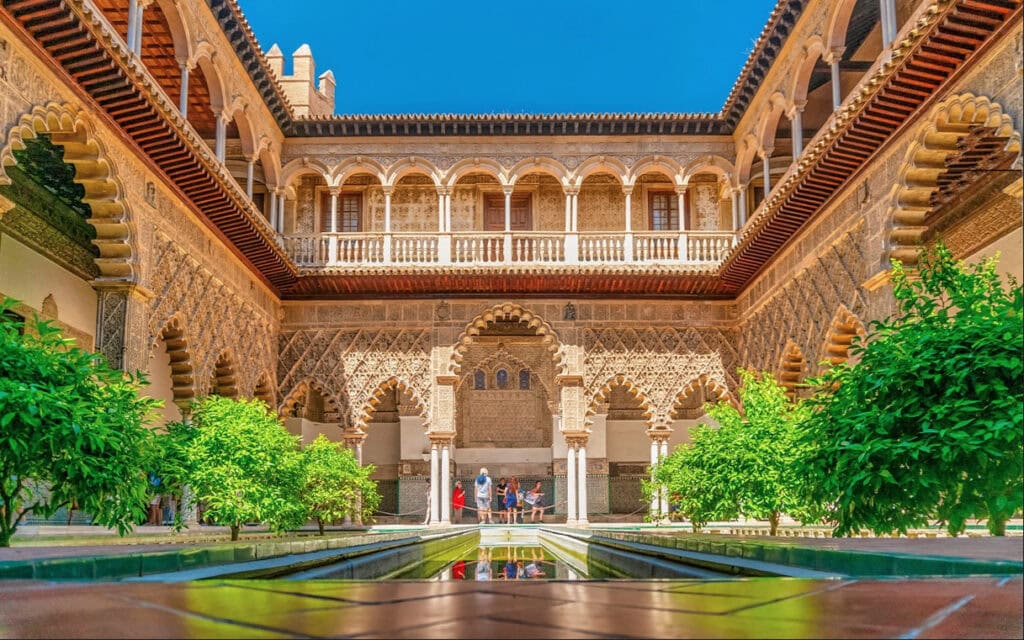
Monuments in Seville showcase the city’s incredible history and mix of cultures better than anything else. From Moorish towers and Gothic cathedrals to royal palaces and grand plazas, each landmark tells a story about the civilizations that shaped Seville.
Walking through the city feels like stepping into an open-air museum, where every stone, arch, and courtyard reflects centuries of art and architecture.
You’ll find Islamic, Gothic, Renaissance, and Baroque influences all coexisting beautifully here. The Seville Cathedral and the Giralda Tower rise proudly in the city center, while the Alcázar of Seville dazzles visitors with its intricate tilework and peaceful gardens.
Add to that the Plaza de España, La Maestranza bullring, and dozens of smaller churches, palaces, and historic buildings, and you’ve got a city that truly celebrates its heritage.
In this guide, I’ll walk you through the most famous Seville monuments you shouldn’t miss, share a simple walking route to see them all, and give you plenty of local tips to make your visit smooth and enjoyable.
If you’re planning to start exploring the city’s top attractions, don’t miss my full guides to the Royal Alcázar of Seville and the Seville Cathedral, plus my Alcázar tickets guide and Cathedral tickets guide for skip-the-line advice.
The top monuments in Seville you shouldn’t miss
There’s no shortage of breathtaking monuments in Seville, but a few stand out as absolute must-sees. These landmarks capture the city’s history, beauty, and cultural mix better than anywhere else.
The Royal Alcázar of Seville
A masterpiece of Mudéjar architecture, the Royal Alcázar is one of Spain’s most beautiful palaces, and one of the most famous Seville monuments. Built by Moorish kings and later expanded by Christian rulers, it’s a stunning blend of Islamic art, Gothic arches, and Renaissance touches.
Wander through its ornate courtyards, admire the colorful azulejo tiles, and don’t miss the peaceful gardens filled with fountains and orange trees. You might also recognize it from ‘Game of Thrones’: it appeared as the Water Gardens of Dorne.
Plan your visit:
- First timer’s guide to the Alcázar of Seville
- Alcázar gardens Seville: A complete visitor’s guide
- How to buy your Alcázar Seville tickets
Insider tip: Get a Sevilla Card, and visit as soon as it opens (9:30). It fills up quickly, and early light makes the tilework glow beautifully in photos.
Seville Cathedral and the Giralda Tower
The Seville Cathedral is the largest Gothic church in the world and a UNESCO World Heritage Site. Inside, you’ll find Christopher Columbus’s tomb, golden altarpieces, and soaring ceilings that leave everyone speechless.
Climb the Giralda Tower, the cathedral’s former minaret, for the best views of the city. The climb is surprisingly easy, thanks to its ramps instead of stairs. Together, they’re two of the most iconic monuments in Seville.
Plan your visit:
- First timer’s guide to the Seville Cathedral
- Giralda Tower Seville: The complete visitor’s guide
- How to buy Cathedral Seville tickets (and avoid the long lines)
Insider tip: Your Cathedral ticket also grants entry to Iglesia del Salvador, many visitors don’t realize this.
Archivo de Indias
Right next to the Cathedral, this elegant Renaissance building houses thousands of documents from Spain’s colonial empire, including letters signed by Christopher Columbus.
The Archivo de Indias is small but fascinating, and best of all, it’s free to enter. It completes Seville’s trio of UNESCO World Heritage Sites, together with the Cathedral and the Alcázar.
- Plan your visit to Archivo de Indias.
- Don’t miss: The inner courtyard and exhibition halls.
Insider tip: Depending on your entry time, pop in right before or after seeing the Cathedral, it’s free!
Iglesia del Salvador
Often overlooked by first-time visitors, the Iglesia del Salvador (Church of the Divine Saviour) is one of the most beautiful monuments in Seville and a real hidden gem. Built on the site of a former mosque, it’s the city’s second-largest church after the Cathedral and a wonderful example of Spanish Baroque architecture.
Inside, the decoration is breathtaking. Golden altarpieces, elaborate sculptures, and richly painted domes fill the space with light and color. The main altar, created by Cayetano de Acosta, is a masterpiece that easily rivals anything inside the cathedral.
If you look closely at the church’s exterior, you’ll notice traces of its Islamic past, especially in the courtyard, which once served as the mosque’s ablution patio. It’s a quiet, atmospheric spot and a reminder of Seville’s layered history.
Don’t miss: The main altarpiece and the peaceful courtyard.
Insider tip: Your ticket to the Seville Cathedral usually includes entry to Iglesia del Salvador, so keep it handy and visit both on the same day.
Plaza de España
Built for the 1929 Ibero-American Exhibition, Plaza de España is one of Seville’s most impressive open spaces and a true architectural gem. Its sweeping semi-circular design is decorated with colorful tiles representing all the provinces of Spain.
Stroll along its bridges, rent a boat to paddle around the canal, or simply sit and take in the atmosphere: it’s a favorite spot for photos and people-watching.
- Plan your visit to Plaza de España.
- Don’t miss: The tiled alcoves and the viewpoint on the upper gallery.
Insider tip: Climb the stairs to the upper balcony for the full semi-circular view.
Torre del Oro Maritime Museum
Standing proudly on the banks of the Guadalquivir River, the Torre del Oro was built in the 13th century as part of Seville’s defensive walls. Its golden shine once symbolized the wealth brought from the Americas.
Today, it houses a small maritime museum and offers great views over the river and Triana district from the top.
- Plan your visit to the Torre del Oro Maritime Museum.
- Don’t miss: The rooftop terrace, a perfect sunset photo spot.
Insider tip: Combine your visit with a river walk or boat tour, both start nearby.
Casa de Pilatos
Often called a “mini Alcázar”, Casa de Pilatos is a private palace that blends Mudéjar, Gothic, and Renaissance styles. It’s less crowded than the main attractions and offers a quieter, more intimate experience.
Its courtyard, intricate tiles, and peaceful atmosphere make it one of the most charming monuments in Seville for architecture lovers.
- Plan your visit to Casa de Pilatos.
- Don’t miss: The main patio and the staircase lined with tiles.
Insider tip: Go in the late afternoon for softer light and fewer people. Stand in the main courtyard and look up: the geometric ceilings are incredible!
Metropol Parasol (Las Setas)
To see a modern side of Seville, head to Metropol Parasol, locally known as Las Setas (“The Mushrooms”). This striking wooden structure dominates Plaza de la Encarnación and offers one of the best panoramic views in the city.
Walk along the elevated walkway, grab a drink at the rooftop bar, and stay for sunset: it’s the perfect contrast to Seville’s historic monuments.
Don’t miss: The view of the city roofs (including the Cathedral and the Giralda!) from the top deck.
Insider tip: There’s a local market under the structure, grab a snack there if you visit before 15:00.
Hospital de la Caridad
The Hospital de la Caridad is one of the most moving and beautiful monuments in Seville, combining art, faith, and charity in a single space. Founded in the 17th century by Don Miguel Mañara (a nobleman who dedicated his life to helping the poor) it still embodies the spirit of compassion that gave it its name.
The building’s façade is typically Sevillian, with a peaceful courtyard full of orange trees and fountains. Inside, the church is a Baroque masterpiece, decorated with gilded woodwork, vivid frescoes, and sculptures by Pedro Roldán. The walls are adorned with dramatic paintings by Murillo and Valdés Leal that depict themes of charity and salvation.
- Plan your visit to Hospital de la Caridad.
- Don’t miss: The main chapel, the courtyard, and the paintings in the nave, some of the most powerful religious artworks in Seville.
2025 update: The Hospital de la Caridad is currently closed for restoration and is not expected to reopen until at least 2027. I’ll update the information to keep you updated.
Insider tip: Even though you can’t visit inside right now, it’s still worth passing by on your walk along Calle Temprado, near the Guadalquivir River. The exterior and its history make it an interesting stop on any cultural route.
A suggested walking route through Seville’s monuments
If you only have a short time in the city, or you want to hit the major monuments while staying relaxed, this walking route is ideal.
Better yet: my guidebook “Seville in Two Days” gives you three self-guided walks, accurate maps and insider tips so you don’t just stumble around, you explore like a local.
Day 1 (morning): The river and city views
- A gentle introduction to the city through the Guadalquivir River and Triana neighborhood.
- You start at the Torre del Oro, enjoy a river cruise, walk along Calle Betis, visit Iglesia de Santa Ana, and explore Triana Market.
Day 1 (afternoon): The city center
A walk through the historic center, starting at the Iglesia del Salvador and the Roman ruins of the Antiqvarivm, continuing to the Metropol Parasol (Las Setas) for panoramic views, and ending with a flamenco show to experience Seville’s soul.
Day 2: Iconic monuments
A complete itinerary covering the city’s most iconic monuments: the Royal Alcázar, Seville Cathedral, and Giralda Tower in the morning, followed by a stroll through Santa Cruz, and an afternoon visit to Plaza de España, Parque de María Luisa, and El Arenal with its famous bullring.
Why use the guidebook?
- The guidebook gives you detailed maps (including links to customized Google Maps) for each walk so you know exactly where you’re going. No guesswork!
- It includes insider tips, like the best time of day to visit each monument (and when to avoid lines or heat).
- It saves you time: rather than researching each place yourself, the book puts everything together in one place, based on my first-hand testing in Seville.
Quick checklist before you set off
- Wear comfortable shoes as there will be a lot of walking.
- Bring a water bottle, especially if you’re visiting in warmer months.
- Download or bring the guidebook PDF so you can follow the route even if your phone loses signal.
- Start early (around 9:00 or 10:00) if you can. Many monuments open then and it’s quieter.
- Leave some time in the evening to simply unwind in a square or by the river; Seville deserves some slow moments too.
Map of the best sights and museums in Seville
To help you plan your trip, I’ve created a detailed map of Seville’s top museums and must-see sights. You’ll find all the places mentioned in this guide (from the Museum of Fine Arts and Casa de Pilatos to hidden gems like Centro Cerámica Triana) plus my favorite walking routes, viewpoints, and cafés nearby.
Use it to organize your days, group attractions by area, and make the most of your time in Seville without backtracking across the city.
Explore more with ‘Seville in Two Days’
If you loved discovering Seville’s monuments, you’ll want to take your trip to the next level. My guidebook ‘Seville in Two Days’ helps you explore the city with three complete itineraries, detailed maps, and local food recommendations that make planning effortless.
Inside, you’ll find:
- Step-by-step walking routes to visit every major monument without missing hidden gems.
- Restaurant and tapas suggestions along the way, tested and loved by locals.
- Printable and Google Maps versions for easy navigation offline or on your phone.
- Bonus section with extra sights for longer stays.
Whether you’re visiting Seville for a weekend or planning a short stop on a Spain tour, ‘Seville in Two Days’ is the easiest and smartest way to see the city like a local.
Get your copy of ‘Seville in Two Days’ now and start exploring Seville with confidence and style.
