
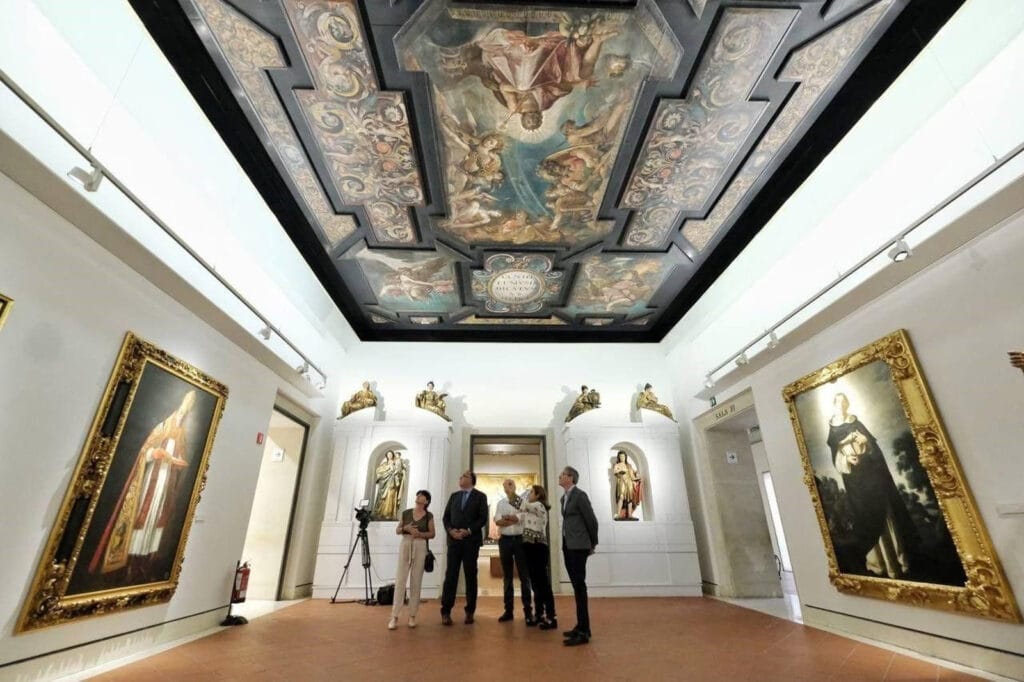
If you love art, history, or just want to understand Seville a little better, its museums are the perfect place to start. From world-class galleries to small, hidden gems, the museums in Seville tell the city’s story through paintings, traditions, and everyday life.
What I love most about Seville museums is how different they are from one another.
One moment you’re standing in front of a Baroque masterpiece by Murillo at the Museum of Fine Arts, and the next you’re watching a live flamenco performance at the Flamenco Dance Museum. There’s something for everyone, whether you’re into ancient Roman history, modern art, or Andalusian culture.
In this guide, I’ll walk you through the best museums in Seville, including the must-see classics and some smaller, lesser-known spots that locals adore. You’ll also find practical information (opening hours, ticket prices, and smart tips) so you can plan your visits without wasting time.
Visiting these art museums in Seville is one of the best ways to connect with the city’s history, creativity, and everyday life.
Museo de Bellas Artes (Museum of Fine Arts)
If you visit just one museum, make it this one as it’s one of the best museums in Seville. Housed in a beautiful former convent from the 17th century, the Museum of Fine Arts is often called Spain’s “second Prado”.
Inside, you’ll find masterpieces by great Sevillian painters like Murillo, Zurbarán, and Valdés Leal. The rooms are calm and cool, with quiet courtyards filled with orange trees, perfect for a mid-morning visit.
What to see:
- The old cloister: a quiet, green courtyard lined with pretty azulejos (ceramic tiles). We loved taking a slow stroll here before leaving.
- Room V, set inside the former church. You’ll be amazed by the high ceilings and peaceful light. The large Murillo canvases displayed here are absolutely stunning.
- Cabeza de apóstol (1620) by Diego Velázquez, shown in Room 4. This painting will surely move you; it captures the naturalist style so simply and powerfully.
Useful info:
- Plaza del Museo, 9
- Open Tuesday-Saturday 9:00-21:00, Sunday 9:00-15:00, closed Monday.
- Time needed: 1.5-2 hours.
- Full guide on the Seville Museum of Fine Arts.
- Save time and book your guided tour.
Insider tip: Go early, when the museum is quiet, then grab a coffee nearby at Plaza del Museo.
Museo del Baile Flamenco (Flamenco Dance Museum)
Created by the famous dancer Cristina Hoyos, the Flamenco Museum is one of Seville’s most unique cultural experiences. It’s both a museum and a small theater, where flamenco truly comes alive.
You can explore interactive exhibits about the origins of flamenco, its music and costumes, and then stay for a live show in the evening.
What to see:
- On the first floor, sound installations and short videos explain the origins of flamenco: its roots, rhythms, and influences.
- In the main hall, you can watch and listen to the seven main rhythms that define this passionate Sevillian dance.
- The next rooms explore the evolution of flamenco venues, showing how performances moved from private patios to grand stages.
- There’s also a charming space displaying costumes, shoes, and personal objects belonging to well-known flamenco artists.
- Don’t miss the top floor, where a small but vibrant contemporary art collection celebrates flamenco’s creative spirit.
Useful info:
- Calle Manuel Rojas Marcos, 3
- Museum open daily 11:00-18:00; shows at 17:00, 19:00 and 20:45.
- Visit duration: 1-1.5 hours (plus show).
- Full guide on the Flamenco Museum.
- Get your tickets for the Puro Flamenco Show.
Insider tip: Book your show in advance. Seats are limited and sell out quickly, especially on weekends.
Antiqvarivm de Sevilla (Roman Ruins under Las Setas)
Hidden beneath the striking modern structure of Las Setas de Sevilla, the Antiqvarivm offers a journey far back in time. This underground museum preserves the Roman and Moorish remains discovered during the construction of Las Setas, revealing what Seville looked like nearly 2,000 years ago.
The site is beautifully presented, with raised walkways that let you wander above the ruins while learning about the ancient city of Hispalis. You can see the foundations of Roman houses, intricate mosaics, water systems, and pottery. Interactive panels and lighting make it easy to imagine how daily life unfolded here centuries ago.
What to see:
- The Roman mosaics, especially the geometric designs that have survived almost intact.
- The ancient walls and floors. You can clearly see how different layers of the city were built over time.
- The contrast. Standing under the ultra-modern Las Setas while exploring ancient ruins is a unique experience.
Useful info:
- Plaza de la Encarnación, directly under Las Setas.
- Open Tuesday-Saturday 10:00-20:00, Sunday 10:00-14:00, closed Monday.
- Visit duration: 45 minutes-1 hour
Insider tip: Visit in the afternoon, then head upstairs before sunset to the Las Setas viewpoint for a completely different perspective of Seville, from ancient ruins to panoramic rooftops.
Museo Marítimo Torre del Oro (Naval Museum)
Standing proudly on the banks of the Guadalquivir River, the Torre del Oro is one of Seville’s most iconic landmarks, and home to a small but fascinating naval museum. Built in the 13th century by the Almohads as part of the old city walls, this golden tower once guarded the port and controlled access to the river.
Inside, the museum tells the story of Seville’s maritime history, when the city was the main gateway between Spain and the Americas. The displays are simple but interesting, featuring model ships, maps, navigation tools, and old documents that show how important the river once was for trade and exploration.
And the best part? You can climb to the top of the tower for one of the most beautiful panoramic views in Seville: the river, the Triana Bridge, and the cathedral skyline all spread out before you.
What to see:
- The ship models. Detailed and beautifully crafted, they help you imagine the voyages that began right here in Seville.
- The historical maps. Fascinating for understanding how explorers navigated between Spain and the New World.
- The rooftop view. The short climb is absolutely worth it for the stunning view over the Guadalquivir and Triana.
Useful info:
- Paseo de Colón, by the Guadalquivir River
- Open Monday-Friday 9:30-19:00, weekends and holidays 10:30-19:00.
- Visit duration: 30-45 minutes.
- Full guide on the Torre del Oro Naval Museum.
Insider tip: Go early in the morning or close to sunset as the light over the river is magical, and you’ll avoid the midday crowds. Afterwards, enjoy a walk along the riverside promenade or cross the bridge into Triana for tapas.
Centro Cerámica Triana (Triana Ceramics Center)
In the heart of Triana, Seville’s traditional pottery district, the Centro Cerámica Triana celebrates one of the city’s oldest and most beautiful crafts.
The museum is located on the exact site of a former ceramics factory, where tiles and pottery were made for centuries. Walking through it feels like stepping into the history of a neighborhood that supplied azulejos to Seville’s churches, palaces, and patios.
The space is modern and well-designed, but it keeps traces of the old factory: you can still see the original kilns, drying racks, and clay basins. Interactive displays explain the full process, from molding and glazing to firing. Upstairs, exhibitions showcase colorful ceramic tiles, plates, and sculptures, many of them authentic pieces from Triana’s golden age of craftsmanship.
What to see:
- The restored kilns. Beautifully preserved and easy to imagine in use centuries ago.
- The tile displays. Vibrant examples of the classic blue-and-white Andalusian style.
- The videos and exhibits. Simple but engaging explanations of how ceramics became part of Seville’s identity.
Useful info:
- Calle Callao, 16 in the Triana district, near the Triana Market and San Jorge Castle
- Open Tuesday–Sunday 10:00-20:00, closed Monday,
- Visit duration: 45 minutes-1 hour.
- Full guide on the Centro Ceramica Triana.
Insider tip: Combine this visit with a stroll through Triana Market and a stop at one of the nearby tile shops. You’ll find beautiful handmade souvenirs inspired by the same local tradition.
Centro Andaluz de Arte Contemporáneo (Andalusian Contemporary Art Center)
Set inside a former Carthusian monastery on the island of La Cartuja, this is Seville’s main contemporary art museum. Even if modern art isn’t your thing, the building itself is worth the visit: it’s peaceful, open, and full of history.
The exhibitions change often, featuring Spanish and international artists. You’ll find paintings, installations, sculptures, and video art, all in a fascinating mix of old and new architecture.
What to see:
- The main courtyard. The first thing that will catch your eye is a striking sculpture called ‘Alicia’, created in 2009 by artist Cristina Lucas. It’s inspired by ‘Alice in Wonderland’, specifically the moment when Alice grows uncontrollably after eating the magic cake. A fun and unexpected welcome!
- The chimneys. You can see the old brick chimneys of a ceramics factory up close, and their size and presence will impress you. They’re a powerful reminder of Seville’s industrial past.
- The exteriors. The gardens and green areas outside are peaceful and often empty. While exploring, you’ll stumble upon a small building with an artwork by Olaf Nicolai, made entirely of pearls, a beautiful surprise in such a quiet setting.
Useful info:
- Calle Américo Vespucio, 2 at Isla de la Cartuja.
- Open Tuesday-Saturday 11:00-21:00, Sunday 10:00-15:30, closed Monday.
- Time needed: 1-2 hours (to stroll around the gardens and enjoy a coffee at the cafe).
- Full guide on the Centro Andaluz de arte Contemporáneo.
Insider tip: Don’t miss the room with the tombs of the family who were patrons of the monastery.
Pabellón de la Navegación (Navigation Pavillion)
Located on Isla de la Cartuja, the Pabellón de la Navegación is a nice surprise. From the outside it looks a little outdated, but inside it’s one of the most modern and interactive museums in Seville.
The visit begins with a sound walk among model ships: you can touch the displays, activate the terminals, and listen to fascinating tales of sailors and their voyages. The museum then moves on to explain how navigation techniques have evolved over the centuries. There’s even a fun area where kids can handle objects like rudders and steering wheels.
Before you leave, don’t miss the panoramic tower: it offers an incredible 360º view of Seville and the river. The climb is a bit steep, but the view from the top is absolutely worth it.
What to see:
- The Sea of Light. The immersive first section where you can listen to the stories of sailors setting out on their journeys.
- The Science and Technology Room. You’ll discover the ‘Orcelle’, a fascinating prototype of an ecological boat.
- The Panoramic Tower. A slightly daring climb, but rewarded by breathtaking views over Seville.
Useful info:
- Camino de los Descubrimientos, 2 at Isla de la Cartuja.
- Open Tuesday-Saturday 10:00-19:30, Sunday 10:00-15:00, closed Monday.
- Visit duration: 1-1.5 hours.
- Full guide on the Pabellón de la Navegación.
Insider tip: It’s perfect for families and anyone who enjoys hands-on, interactive museums.
Caixa Forum
Located next to the Torre Sevilla skyscraper, the CaixaForum Sevilla is one of the city’s most modern and dynamic cultural centers.
Opened in 2017, it’s part of the ‘La Caixa Foundation’, which runs similar art spaces across Spain, and it has quickly become one of the best museums in Seville for contemporary exhibitions and cultural events.
The building itself is worth a visit: a sleek architectural space designed by Guillermo Vázquez Consuegra that contrasts beautifully with the surrounding Cartuja area. Inside, you’ll find temporary exhibitions ranging from classic masters to modern design, photography, and science. The museum also hosts concerts, film screenings, family workshops, and talks, so there’s always something new happening.
What to see:
- The exhibitions: diverse and high-quality, with works on loan from top international museums.
- The architecture: minimalist and elegant, with natural light and open spaces.
- The family area: interactive activities and workshops make it a great stop if you’re traveling with kids.
Useful info:
- Calle López Pintado, Torre Sevilla complex at Isla de la Cartuja
- Open daily 10:00-20:00 (including weekends and holidays)
- Visit duration: 1-1.5 hours.
- Full guide on the CaixaForum Seville.
Insider tip: Combine your visit with a stroll along the Guadalquivir River or a coffee break at Torre Sevilla’s shopping and restaurant area. If you’re visiting the Pabellón de la Navegación or CAAC, it’s just a short walk away, perfect for a half-day cultural route around La Cartuja.
Museo de Artes y Costumbres (Museum of Arts and Customs)
Located across from the Archaeological Museum on Plaza de América, this museum is all about Andalusian life: the things people made, used, and wore. You’ll be instantly taken by its beautiful neo-Mudejar façade, built for the 1929 Ibero-American Exposition, which aimed to strengthen cultural ties between Spain, Portugal, the Americas, and Latin America.
Inside, you’ll admire the building’s superb architecture before heading to the first floor, where you’ll find a lovely patio and an exhibition dedicated to Andalusia’s living traditions. The basement has several reconstructed workshops showing the region’s traditional crafts, from ceramics to lace-making and guitar building.
What to see:
- The façade, a stunning example of colorful neo-Mudejar design. Take a moment to enjoy the details before going inside.
- The temporary exhibition room, modern and interactive, offering a fresh look at Andalusian culture and crafts.
- The guitar-making workshop. You’ll love seeing how each part of the instrument comes together. It’s one of the highlights of the basement area.
Useful info:
- Plaza de América, Parque de María Luisa. About a 10-minute walk from Plaza de España.
- Open Tuesday-Saturday 9:00-21:00, Sunday 9:00-15:00, closed Monday.
- Visit duration: 1 hour.
Insider tip: Combine your visit with the Archaeological Museum right across the square, then relax with a walk or picnic in Parque de María Luisa, one of Seville’s prettiest green spaces.
Museo Arqueológico (Archaeological Museum)
2025 update: The museum is currently closed for renovation, but it’s scheduled to reopen in 2027 with updated exhibits and a fully modernized layout. Once complete, it’s expected to become one of the most engaging and educational museums in Seville for anyone interested in archaeology and history.
Located in Plaza de América, right across from the Museum of Arts and Popular Traditions, this museum is one of Seville’s true treasures. Housed in a grand building originally constructed for the 1929 Ibero-American Exposition, it holds an important collection of artifacts that trace the history of Andalusia from prehistoric times to the Middle Ages.
The museum’s permanent collection includes Roman sculptures and mosaics from the ancient city of Itálica, as well as Mudejar objects from the period of the Reconquista. The impressive neo-Renaissance façade alone is worth a stop as you walk through María Luisa Park.
What to see (once reopened):
- Treasures from the Roman city of Itálica, including mosaics and statues.
- Artifacts from the Tartessian and Iberian civilizations.
- Mudejar ceramics and objects from the medieval period.
Useful info:
- Plaza de América, Parque de María Luisa. About a 10-minute walk from Plaza de España.
- Opening hours (subject to change): Tuesday-Saturday 9:00-21:00, Sunday 9:00-15:00, closed Monday.
- Visit duration: 1-1.5 hours.
How to visit the museums in Seville
Free entry days & discounts
- Most state-run museums (like the Museo de Bellas Artes, the CAAC, Fine Arts Museum and Archaeological Museum) are free for EU citizens, and only 1.50€ for others.
- Free Sundays: many museums are free on Sunday afternoons, though hours can vary.
- Students & seniors often receive 50% off or free admission so bring an ID.
Planning your visits
- Closed Mondays: nearly all major museums close on Mondays, so plan another activity that day.
- Best time to visit: early afternoons (14:00-16:00) for quiet visits and mornings (9:00– 11:00) for cooler temperatures.
- Average visit time: Smaller museums take about an hour, while the Fine Arts Museum and CAAC deserve 1.5-2 hours each.
- Summer tip: Use museums as a midday refuge as they’re air-conditioned and rarely crowded.
Museum areas at a glance
- Historic center: Museum of Fine Arts, Flamenco Museum, Antiqvarivm, Torre del Oro.
- Triana: Centro Cerámica Triana.
- Parque de María Luisa: Museum of Arts and Popular Traditions, Archaeological Museum.
- Isla de la Cartuja: CAAC (Contemporary Art Center), Pabellón de la Navegación and CaixaForum.
Insider tip: If you’re planning to visit several places over two or three days, group them by area rather than by theme. You’ll walk less and see more. For example:
- Day 1: Fine Arts Museum + Torre del Oro + Triana ceramics
- Day 2: Flamenco Museum + Antiqvarivm
- Day 3: Isla de la Cartuja museums
Map of museums in Seville
Here’s a handy map of museums in Seville to help you plan your visits. You’ll find all the places mentioned in this guide, from the Museum of Fine Arts and the Flamenco Dance Museum to lesser-known gems like the Centro Cerámica Triana and the Palacio de la Condesa de Lebrija.
Use it to see which museums are close to each other, plan walking routes, or create your own cultural itinerary around the city.
