

The Estadio Ramón Sánchez Pizjuán—the legendary ‘Bombonera de Nervión’—stands as the soulful, high-intensity heart of Sevilla FC.
2026 Stadium fast facts
- 2026-2027 Status: Following a project delay, the stadium remains fully operational for the entire 2026-2027 season.
- Upcoming move: The official demolition is now scheduled for June 2027, at which point Sevilla FC will move to La Cartuja for two seasons.
- Best way to arrive: Metro Line 1 to Nervión or Gran Plaza station.
- The must-see: The historic mosaics on the stadium façade (Calle Sevilla Fútbol Club).
Check Sevilla FC tickets for the final home games. Here’s a complete guide to do so, in case you need it.
The stadium has hosted Sevilla FC matches since 1958 and is famous for its intense matchday atmosphere and compact design. Located in the lively Nervión district of Seville, the venue sits within walking distance of major transport hubs and busy shopping streets.
Although the €350 million ‘Nuevo Pizjuán’ project is looming, the club has confirmed that construction will not begin until June 2027. This gives fans one more full season to experience the legendary atmosphere of the original ‘Bombonera’ before the team’s temporary relocation.
Whether you’re planning to watch a game, take the stadium tour, or simply explore one of Seville’s most iconic sports landmarks, this guide explains everything you need to know before your visit.
Where is the Ramón Sánchez Pizjuán?
The Estadio Ramón Sánchez Pizjuán is located in the heart of Nervión, a bustling, modern district just east of Seville’s historic center.
Unlike many modern stadiums built on the outskirts of cities, the Pizjuán is fully integrated into the urban fabric. It’s surrounded by high-street shops, tapas bars, and residential apartment blocks, which is exactly why the matchday atmosphere feels so personal and intense.
Address: Calle Sevilla Fútbol Club, s/n, 41005 Sevilla.
Proximity to key landmarks
- The historic center (Catedral/Giralda): Approximately 2 km (1.2 miles) away. It’s a flat, easy 25-minute walk from the Cathedral or a 10-minute taxi ride.
- Santa Justa train station: The stadium is a mere 1.2 km (0.7 miles) from Seville’s main high-speed train hub. You can literally see the stadium floodlights as you walk out of the station.
- Nervión Plaza Mall: Located directly adjacent to the stadium’s West Stand (Preferencia). This is the primary meeting point for fans before and after the game.
The Nervión experience
Visiting the stadium isn’t just about the 90 minutes of football. The neighborhood is a major commercial destination in its own right. On non-matchdays, the area is a paradise for shoppers, featuring the Nervión Plaza mall and the iconic El Corte Inglés department store.
On matchdays, however, the district undergoes a transformation. The wide avenues like Avenida de Eduardo Dato and Calle Luis de Morales become rivers of red and white, and the local tapas bars (like the legendary Cervecería El Tremendo) overflow with fans.
Sandra’s 2026 insider tip: If you want the best photo of the stadium without the matchday crowds, head to the top floor of the Nervión Plaza shopping center. The rooftop terrace offers a stunning panoramic view of the stadium’s historic mosaic facade.
The “Nuevo Pizjuán” Project: Reconstruction starting June 2027
If you’re visiting in 2026, you’re witnessing the stadium in its final original form, but the farewell has been extended.
The club officially announced in late 2025 that the demolition phase has been moved to the end of next season, meaning the stadium remains the club’s active home until May 2027.
The 2026–2028 construction timeline
The club’s roadmap is now clear, and it will significantly impact how fans experience matches over the next two years:
- June 1, 2027: Scheduled groundbreaking. Following the final match of the 2026-27 season, the site will be handed over to developers.
- The “La Cartuja” Era: For the 2027-2028 and 2028-2029 seasons, Sevilla FC will play all home matches at the Estadio de La Cartuja. Unlike their rivals Betis, who moved there in 2025, Sevilla will be moving into a football-ready La Cartuja with the athletics track already removed.
- August 2029: The scheduled grand opening of the “Nuevo Pizjuán.”
Although the redevelopment has been widely discussed by the club and local authorities, construction timelines may evolve depending on planning approvals and project phases.
What the new stadium will look like
The 2026 design project focuses on increasing the pressure cooker atmosphere that has made the stadium legendary, while adding modern amenities:
- Capacity increase: Growing from 42,700 to 55,000 seats.
- The lowered pitch design: To avoid building a taller stadium that would block the Nervión skyline, the club will lower the pitch level. This allows for a steeper, more compact bowl where fans are even closer to the players.
- A full roof: Every seat will finally be covered, protecting fans from Seville’s extreme heat and the occasional winter rain.
- 365-day activity: The new stadium will function as a commercial hub for the Nervión district, featuring a year-round museum, events space, and dining.
Sandra’s 2026 context: President Del Nido Carrasco recently emphasized that the new stadium will “finance itself” through increased VIP and matchday revenue. For you, the visitor, this means that every ticket you buy in this final season is part of the legacy that builds the club’s future home.
Ramón Sánchez Pizjuán seating guide
The stadium is designed as a tight, rectangular bowl that brings the fans incredibly close to the touchline. Because it’s largely uncovered, your primary considerations should be sun exposure and the intensity of the crowd.
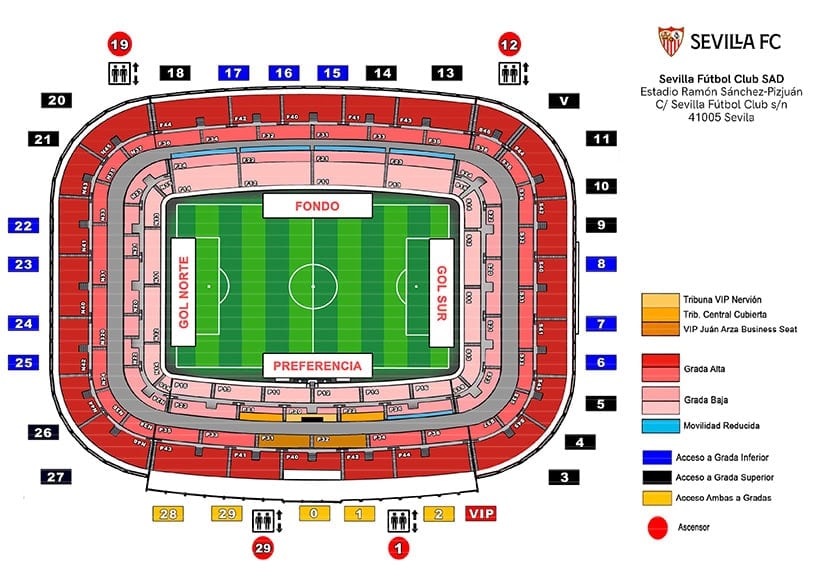
Preferencia (West Stand)
This is the VIP side of the stadium, housing the presidential box, the press area, and the players’ tunnel.
- The big advantage: It’s the only stand with a permanent roof.
- The shadow factor: If you’re attending an afternoon match (4:00 PM or 6:30 PM), this is the place to be. You’ll be in the shade while the rest of the stadium faces the sun.
- Best for: Families, luxury seekers, and those who want a broadcast-style view of the tactics.
Fondo (East Stand)
Located directly opposite the Preferencia, the Fondo is a massive, two-tiered stand.
- The sun warning: This stand faces West. For afternoon games, you will be in direct sunlight until the sun dips behind the Preferencia.
- The atmosphere: This is a loud but civilized section. It offers a great balance of intense cheering without the constant standing required in the ends.
- Best for: First-time visitors who want a great view and a passionate (but not overwhelming) experience.
Gol Norte (the “Bombonera” heart)
This is the North End, the domain of the Biris Norte (Sevilla’s Ultras).
- The vibe: This is the engine room of the stadium. It’s a sea of flags, drums, and non-stop singing.
- Accessibility: Most of the lower tier is occupied by long-term season ticket holders. If you find a ticket here, be prepared to stand for the entire 90 minutes.
- Best for: Hardcore football fans who want to be in the middle of the noise.
Gol Sur (family and away end)
The South End is traditionally more relaxed than the North.
- Away fans: The visiting supporters are located in the highest section of the South-East corner, separated by security glass.
- The view: Like the Gol Norte, these seats offer a goal-to-goal perspective, which is great for seeing attacking plays develop.
- Best for: Budget-conscious travelers and families.
Sandra’s 2026 seating checklist:
- Avoid the Fila 1 (Row 1): Unlike modern stadiums, the front row at the Pizjuán is slightly below the pitch level behind a security wall. Your view will be partially obscured by the grass and the advertising boards. Aim for Row 10 or higher.
- The “Voladizo” trick: In the Preferencia, the upper tier is called the Voladizo. These seats are high up but offer a spectacular, God’s-eye view of the game while staying fully under the roof.
- Check for “Sombra” (Shade): When booking, always prioritize tickets labeled Sombra. If you’re in Sol (Sun) during a May match, the Seville heat can be punishing.
Matchday atmosphere and pre-match bars in Nervión
The matchday experience at Sevilla FC doesn’t begin with the opening whistle; it begins two hours earlier in the surrounding streets. Because the Pizjuán is so tightly integrated into the neighborhood, the entire district of Nervión turns into an open-air festival of red and white.
Where to experience la previa (the build-up)
The previa is the sacred Spanish tradition of gathering for tapas and beers before the game. For the best atmosphere, head to these specific spots:
- Calle Luis de Morales: This is the main artery leading to the stadium from the Santa Justa station. It becomes a sea of fans singing and walking toward the West Stand.
- La Taberna de Juan: Located on Calle Hernando del Pulgar (near the stadium), this is a local institution. In 2026, it remains the “gold standard” for the coldest beer in Seville. It’s where old school fans meet to discuss the lineup.
- Bar Las Palmas: Tucked away near the stadium, this bar is famous for its fried fish and its wall-to-wall Sevilla FC memorabilia. It’s standing-room only, and the energy is infectious.
- Nervión Plaza Terraces: If you prefer a more modern vibe, the outdoor terraces of the Nervión Plaza mall offer a great vantage point to watch the crowds gather while enjoying a tinto de verano.
The must-see façade: The great mosaic
Before you enter, you must stop at the main West Façade on Calle Sevilla Fútbol Club.
- The 1982 mosaic: This massive, stunning artwork features the crests of the teams that played in the 1982 World Cup at the stadium.
- 2026 context: Since this facade will be preserved or replicated in the new stadium design, taking a photo here in the original setting is a priority for every visitor this season.
The most important moment: The anthem
Don’t be late for kickoff. You need to be in your seat at least 15 minutes before the match starts.
The singing of the “Himno del Centenario” by El Arrebato is widely considered the best pre-match ritual in world football.
- The experience: 42,000 fans hold their scarves high and sing acapella. The acoustics of the Pizjuán’s steep stands create a wall of sound that is truly spine-tingling.
- Sandra’s 2026 tip: Even if you aren’t a Sevilla fan, learn the chorus: “¡Y Sevilla, Sevilla, Sevilla, aquí estamos contigo Sevilla!” It’s the moment you truly feel the ‘Bombonera’ come alive.
Best ways to reach the stadium (transport guide 2026)
Reaching the Ramón Sánchez Pizjuán is a breeze compared to other major European stadiums. Whether you’re coming from the airport, the historic center, or the train station, here’s your 2026 transport masterplan.
Quick comparison: Matchday transport
| Method | Best For… | Station/Stop | Travel Time |
| Metro (Line 1) | Speed & Reliability | Nervión or Gran Plaza | 6 min from Center |
| Walking | The Matchday Ritual | Via Luis de Morales | 15 min from Santa Justa |
| Bus (TUSSAM) | Affordability | Luis de Morales / Eduardo Dato | 15–20 min |
| Tram (T1) | Scenic Route | Eduardo Dato | 25 min from Plaza Nueva |
| Taxi / Uber | Direct Comfort | Calle Luis Montoto (Drop-off) | 10–15 min |
Metro (Line 1)
The Metro is the most efficient way to reach Nervión.
- The route: From the city center, board at Puerta Jerez (near the Cathedral) heading toward Olivar de Quintos.
- The stop: Get off at Nervión. The station exit is directly in front of the stadium’s main façade.
- Sandra’s 2026 hack: If the Nervión station is too crowded (common after a big win!), walk 8 minutes to the Gran Plaza station. You’ll beat the crush and usually get a seat for the ride back.
Walking
From the city centre
If you’re staying in the central district, walking can be a pleasant option.
Approximate walking time from the historic centre (Cathedral area): roughly 30–35 minutes.
From Santa Justa train station
If you’re staying near the train station or arriving via AVE, don’t take a taxi.
- The walk: It’s a flat, easy 1.1 km (12-minute) stroll. Exit the station onto Avenida de Kansas City and follow the floodlights down Calle Luis de Morales.
- The vibe: This walk takes you past dozens of fan-filled bars and the Nervión Plaza mall, making it the perfect introduction to the neighborhood’s football soul.
TUSSAM bus and Tranvibus (TB1)
In 2026, the bus network is more robust than ever.
- Standard lines: Lines 5, 21, 27, 28, 29, 32, C1, and C2 all serve the stadium area.
- The TB1 (Tranvibus): This high-capacity electric line connects the East side of the city directly to the stadium. It’s fast, modern, and has dedicated lanes.
- Note: During the 2026 season, expect diversions 90 minutes before kickoff as police close the immediate perimeter for fan safety.
Taxi or ride-share
Taxis and ride-share services are widely available across Seville and can drop passengers close to the stadium.
However, immediately after the final whistle traffic congestion and high demand may lead to longer waiting times. Walking a few blocks away from the stadium before requesting a ride can make pickups easier.
Driving and parking: avoid it!
I strongly discourage driving to a Sevilla FC match. The streets around the stadium are restricted to residents, and traffic in Nervión is brutal on matchdays. However, if you must drive:
- The best bet: Use the Saba Parking at Santa Justa Station. It’s large, secure, and far enough from the stadium that you won’t get trapped in the post-match road blocks.
- Avoid: The underground lot at Nervión Plaza Mall. While it’s the closest, it can take over 45 minutes just to exit the garage after the final whistle.
The Sevilla FC Stadium Tour: “The Last Chapter” Experience
The 2026 “Last Chapter” tour has been extended due to the project delay, allowing visitors to explore the stadium’s 70-year history in its original state through Spring 2027.
What’s included in the 2026 Tour?
The tour is a self-guided experience (with an interactive audio guide in English) that takes you through the most exclusive areas of the stadium:
- The Trophy Room: This is the crown jewel. You can see all seven UEFA Europa League trophies displayed together—a sight you won’t find at any other club in the world.
- The Royal Box & Press Room: Sit in the President’s chair and then head to the media room to see where coaches give their post-match interviews.
- The Dressing Rooms: Walk through the first-team locker room where legends like Jesús Navas and Ivan Rakitić prepared for battle.
- The Tunnel & Pitchside: Experience the “Sound of Nervión” as you walk through the tunnel to the edge of the pitch. You can sit in the dugouts and take photos with the iconic mosaic backdrop.
2026 Opening hours and prices
As of March 2026, the tour operates on a specific schedule to accommodate the final preparations for the stadium’s reconstruction:
- Monday: 11:00 AM – 3:00 PM
- Wednesday: 4:00 PM – 8:00 PM
- Thursday to Sunday: 11:00 AM – 3:00 PM and 4:00 PM – 8:00 PM
- Tuesday: Closed for maintenance.
- Matchdays: The tour is closed on matchdays and usually the afternoon before a European fixture.
| Ticket Type | Price (2026) |
| Adults (16+) | €12 |
| Youth (13-15) | €10 |
| Children (6-12) | €6 |
| Infants (0-5) | Free |
Why the Tour is worth it (my take)
The Ramón Sánchez Pizjuán is more than just a football ground: it’s a central part of Sevilla FC’s identity and history. Visiting the stadium provides insight into the club’s traditions, its passionate supporters, and the role the venue has played in Spanish and European football.
For football fans travelling to Seville, the stadium tour is often one of the most memorable sports experiences in the city.
Book the Sevilla FC Stadium Tour online.
Sandra’s 2026 insider tip: Access to the tour is via Entrance 2 (Puerta 2), located on the West Stand (Calle Sevilla Fútbol Club). I highly recommend booking the 5:00 PM slot—the golden hour light hitting the stadium’s exterior mosaic as you finish the tour is a photographer’s dream.
Frequently Asked Questions about Ramón Sánchez Pizjuán Stadium
Where is Ramón Sánchez Pizjuán Stadium located?
The stadium is located in the Nervión district of Seville, just east of the historic centre. It’s within walking distance of major landmarks such as Sevilla-Santa Justa railway station and is only a few minutes from the Nervión metro station.
How do you get to Ramón Sánchez Pizjuán Stadium?
The easiest way to reach the stadium is by metro via Nervión station on Line 1, which is located about a three-minute walk away. Buses, taxis and walking from nearby neighbourhoods are also common ways for supporters to travel to matches.
What is the capacity of Ramón Sánchez Pizjuán Stadium?
The Estadio Ramón Sánchez Pizjuán has a capacity of around 42,700 spectators, making it one of the largest football stadiums in Andalusia. Despite its size, the stands are built close to the pitch, which helps create the intense atmosphere for which the stadium is famous.
What are the best seats at Ramón Sánchez Pizjuán?
For the best overall view, central sections of the Preferencia stand are often recommended. Fans looking for the most intense atmosphere usually choose Gol Norte, where some of the most vocal supporters of Sevilla FC gather during matches.
Can you visit Ramón Sánchez Pizjuán without attending a match?
Yes. The stadium offers an official tour that allows visitors to explore areas such as the museum, trophy room, players’ tunnel and pitchside zones. This is a popular option for football fans visiting Seville outside the match schedule.
How early should I arrive for a Sevilla FC match?
I generally recommend to arrive at least 45–60 minutes before kickoff. This gives you time to pass through security checks, find your seat and enjoy the pre-match atmosphere around the stadium.
Is the stadium safe for visitors?
Yes. The area around the stadium is well organised on matchdays, with visible security presence and large numbers of supporters moving through the Nervión district. As with any large event, visitors should remain aware of their surroundings and keep personal belongings secure.
This article is part of a complete tutorial about football in Seville where you can read all the information you need to attend a football match in the city.
Here is a complete summary of all the guide:
1. Have a look at the Sevilla FC official calendar
2. Get your Sevilla FC tickets
3. How to get to Ramón Sánchez Pizjuán Stadium
4. Check the Real Betis official calendar
5. Purchase your Real Betis tickets
6. How to get to Benito Villamarín Stadium
7. Attend a football game in Spain
8. How to get to La Cartuja Stadium
