
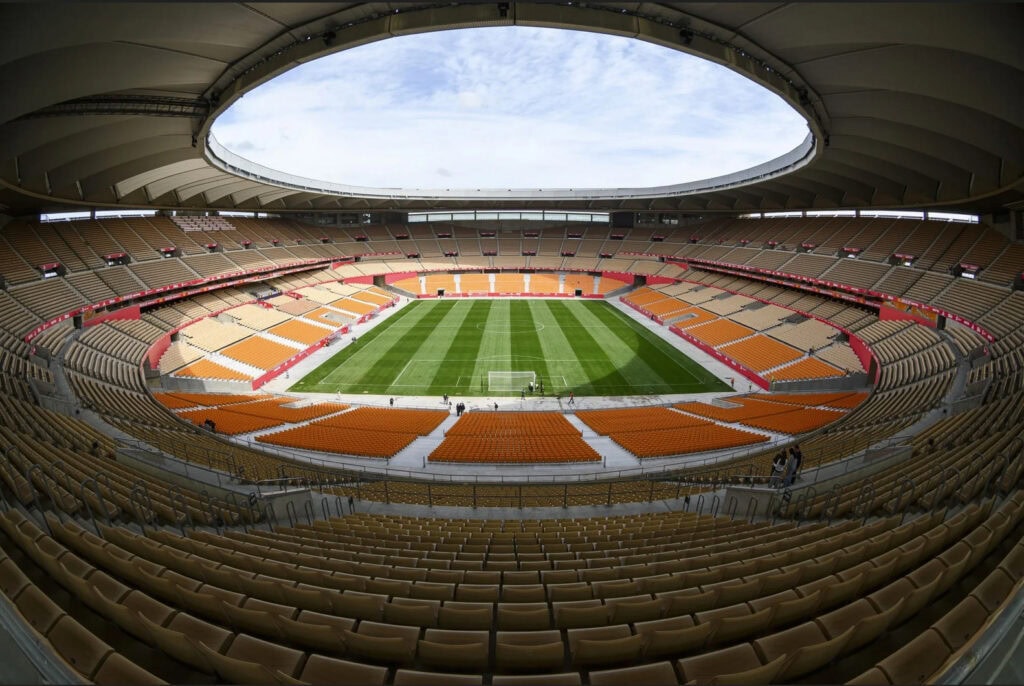
The La Cartuja Stadium has officially entered a new era as the temporary home of Real Betis (2025–2027) and a premier host venue for the 2030 FIFA World Cup. Following a massive €15 million renovation completed in early 2025, this UEFA Elite Stadium has been transformed from an Olympic venue into a world-class football fortress.
2026 Quick guide to La Cartuja Stadium
- Current status: Temporary home of Real Betis (2025–2027).
- Best seats: Choose the Grada Baja (Lower Tier). These are the new 2025 stands that sit directly over the old athletics track, bringing you closest to the pitch. Here’s a complete guide to do so, in case you need it.
- Easiest transport: Take the C1/C2 Bus from the center or the Special Matchday Shuttle from Blas Infante Metro Station.
- Pro tip: Don’t drive. Parking requires pre-registration and the island becomes a bottleneck after the final whistle.
Why is Real Betis playing at La Cartuja? (2025–2027)
If you have visited Seville before, you likely know the Benito Villamarín Stadium—the iconic, green-and-white fortress in the Heliópolis neighborhood. However, for the 2025–2026 and 2026–2027 seasons, that stadium is a construction site.
The Benito Villamarín renovation project
Real Betis has embarked on a massive €100 million+ redevelopment of its home ground. The project began in the summer of 2025 with the complete demolition of the Preferencia (West Stand), which was the oldest part of the stadium.
The goal is to transform the Villamarín into a futuristic, 365-day-a-year destination featuring:
- A new roof covering all 60,000 seats.
- A major increase in VIP hospitality, doubling the business revenue for the club.
- A luxury hotel and clinic integrated directly into the stadium structure.
How long will the “exile” last?
While the club originally hoped for a two-year move, the complexity of the project means a three-season stay at La Cartuja is increasingly likely.
- Current status (2026): Construction is in the heavy foundation and structural phase.
- Estimated return: The official target for the “Grand Opening” is August 2027, though some club insiders suggest the full completion (including the commercial areas) may extend into early 2028.
The 2030 World Cup connection
One of the main reasons for the move to La Cartuja is that Seville is a primary host for the 2030 FIFA World Cup. Both stadiums are being upgraded to meet FIFA’s “Elite” requirements. By moving to La Cartuja now, Betis allows the construction crews to work at full speed, ensuring Seville has two world-class stadiums ready for the global stage.
La Cartuja seating guide: The 2026 configuration
If you haven’t visited the Estadio de La Cartuja since its €15 million transformation in 2025, you might remember it as a drafty Olympic stadium with a massive athletics track.
For the 2025–2027 seasons, the layout has been completely overhauled to make it feel like a football-first venue. Here is how the 2026 seating plan works:
The new Grada Baja: Bringing fans to the pitch
The biggest change in 2025 was the installation of the Grada Baja (Lower Ring). This temporary seating structure was built directly on top of the old running track in the Gol Norte and Gol Sur ends.
- The result: If you sit in the lower rows of the Goles, you’re now just 7 to 9 meters from the grass, similar to the intimacy of the old Villamarín.
- The atmosphere: This is where the Bético supporters’ groups are located. If you want to be in the middle of the singing and flags, this is your section.
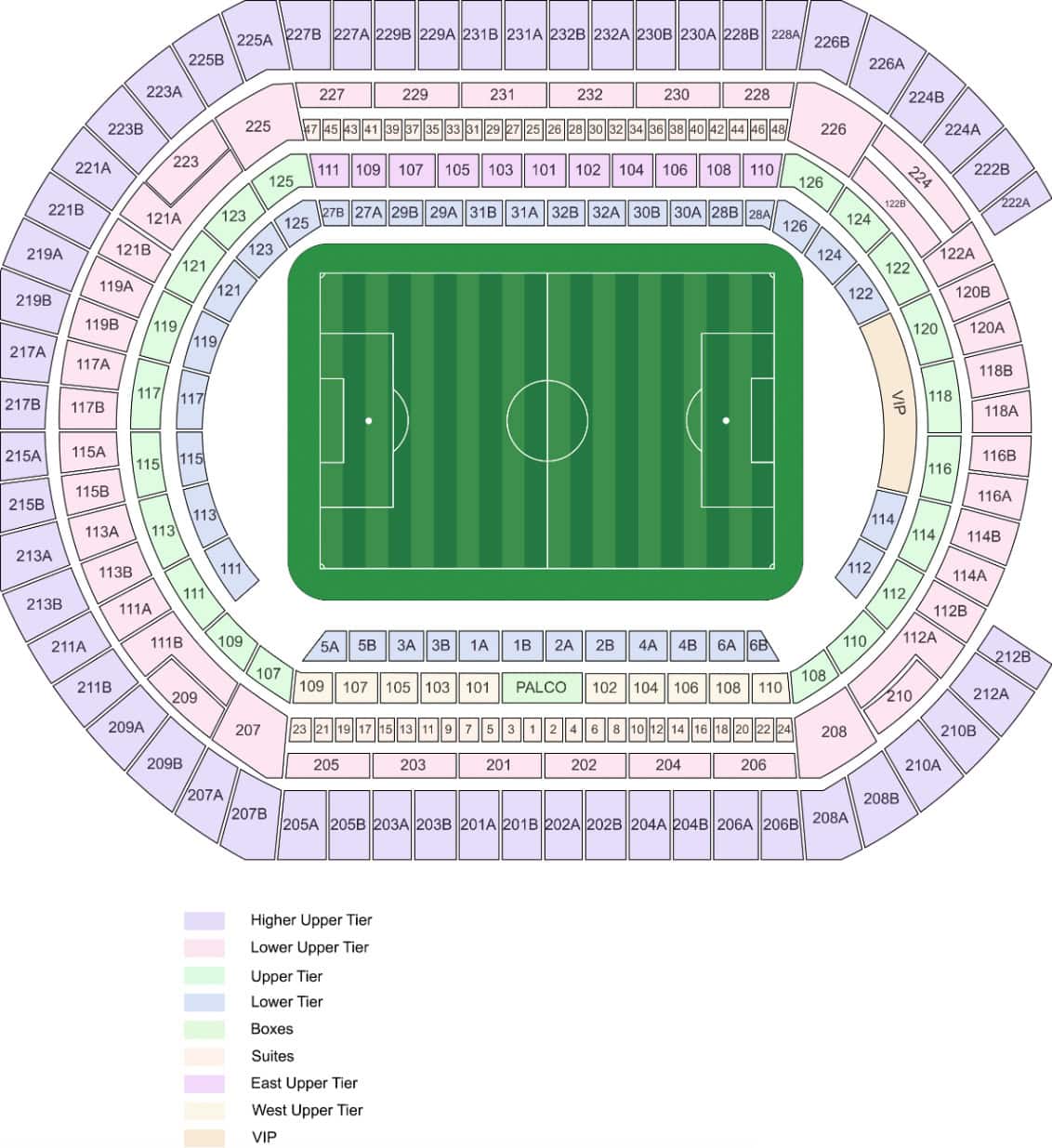
View specific row availability for the next home match on StubHub.
Best sections for view vs. atmosphere
Choosing your seat depends on whether you want a tactical view or a “heart-pounding” experience.
- For the best view (Preferencia & Fondo): The Primer Anfiteatro (First Tier) on the sides of the pitch offers the most balanced view. You’re high enough to see the whole field but close enough to recognize the players.
- For the best vibe (Gol Sur): The Grada Baja (Lower Tier) behind the south goal is the engine room of the stadium. It’s loud, colorful, and intense.
- For luxury (VIP Hospitality): Real Betis has doubled the number of VIP boxes at La Cartuja for 2026. These are located in the Tribuna (Preferencia) and include full Spanish catering and air-conditioned lounges.
The Olympic track warning: Which seats to avoid?
Despite the renovations, La Cartuja is still a massive structure. To ensure you have a great matchday experience, be aware of these sections:
- The Segundo Anfiteatro (Upper Tier): These seats are part of the original stadium structure. Because they sit behind the curve of the old track, you are physically very far from the action. Unless it’s a sold-out derby, try to avoid the top tier.
- Corner flags (Esquinas): Due to the oval shape of the stadium, the “corner” seats can have awkward sightlines where you are looking diagonally across a vast empty space.
- Low rows in the Fondo: While they are close, some low-row seats can have their views slightly obscured by security glass or pitch-side advertising boards.
Sandra’s 2026 seating hack: Always look for tickets labeled “Grada Baja” or “Primer Anfiteatro.” If you see “Segundo Anfiteatro,” you’ll be high in the rafters—bring binoculars!
How to get to La Cartuja Stadium (matchday transport)
| Method | Route / Line | Best For | Practical Notes |
|---|---|---|---|
| Bus (TUSSAM) | C1 & C2 circular lines | Visitors staying in the city centre or near Santa Justa | Frequent service, but can be crowded 60–90 mins before kick-off. |
| Cercanías Train | Line C-2 | Fast access from Santa Justa area | Often quicker than road transport; limited frequency outside peak times. |
| Taxi / Ride-share | Uber, Cabify, local taxis | Convenience & direct travel | Traffic congestion likely near kick-off and after full-time. |
| Walking | Via Barqueta Bridge | Alameda / northern centre | 30–40 min walk; often the most reliable way to leave after the match. |
Reaching the Estadio de La Cartuja is different from the old stadium in Heliópolis. Because it sits on the Isla de la Cartuja (an island on the Guadalquivir), road access is strictly controlled on matchdays. To avoid getting stuck in a taxi queue, use these 2026-specific routes.
The special TUSSAM shuttles (Blas Infante & Barqueta)
For the 2025–2027 seasons, the city of Seville has launched the “Lanzadera Betis”—a dedicated shuttle service that only runs on matchdays.
- The “Metro Link” (Blas Infante): This is the most efficient route. Take Metro Line 1 to the Blas Infante station. From there, a fleet of special shuttle buses departs every 5 minutes directly to the stadium.
- The “Center Link” (C1 & C2): These circular lines connect the city center edges, the Santa Justa Train Station and the Prado de San Sebastián to the stadium. Look for the “E” (Especial) sign on the front of the bus.
- Post-match tip: After the game, these shuttles are free of charge to help clear the 70,000-person crowd as quickly as possible.
Renfe Cercanías: The fastest way from Santa Justa
If you’re arriving in Seville by high-speed train (AVE), don’t take a taxi. Instead, head to the local platforms for the C-2 Cercanías train.
- Journey Time: 15 minutes.
- The stop: Get off at “Estadio Olímpico.”
- 2026 service: Renfe has doubled the number of trains on matchdays, with services departing every 20-30 minutes starting two hours before kickoff.
Walking and cycling: The Barqueta Bridge route
If you’re staying in the Alameda de Hércules, Plaza de Armas or northern central Seville, walking is often faster than sitting in traffic.
- The route: Cross the Puente de la Barqueta (the white suspension bridge). From the bridge, it’s a flat, 45-minute walk (depending on pace) to the stadium gates.
- Cycling: There’s a dedicated bike lane (carril bici) the entire way. You can use the Sevici (public bike share) system, but be aware that the docking stations near the stadium fill up fast on matchdays.
Parking at La Cartuja: The mandatory 2026 registration
I strongly recommend not driving to the stadium. In 2026, police block all private vehicle access to the island 90 minutes before the game.
- Mandatory pre-registration: If you must drive, you must register your license plate on the Real Betis App or website to access the P7 or P8 parking lots.
- The Torre Sevilla hack: A better alternative is to park at the Torre Sevilla Shopping Center garage (which is easy to access) and take a 45-minute walk to the stadium.
Entrances and security at La Cartuja Stadium
Arriving prepared will make your visit to La Cartuja Stadium significantly smoother, especially during Real Betis home matches or large-scale events.
Because the stadium regularly hosts high-attendance fixtures, security procedures are strictly enforced.
When do gates open?
For football matches, gates typically open 90–120 minutes before kick-off, depending on the fixture and competition.
For major matches (derbies, Real Madrid, FC Barcelona or European nights), arriving early is strongly recommended to avoid queues at the security checkpoints.
If your ticket specifies a particular entry gate, head directly there rather than joining the first queue you see.
Security checks
Expect standard stadium security measures, including:
- Bag inspections
- Ticket scanning at electronic turnstiles
- Possible ID verification for certain ticket types
Large backpacks and bulky items may be restricted. Bringing only essential items will speed up entry.
Ticket format and entry
You’ll receive an e-ticket (mobile QR code) or a downloadable PDF.
Ensure your phone is fully charged and that your ticket QR code is easily accessible before reaching the turnstile.
Insider’s tip: Screenshots are usually accepted, but having the original confirmation email available is recommended.
Which entrance should you use?
La Cartuja Stadium has multiple access gates depending on your seating section (Tribuna, Preferencia, Gol Norte or Gol Sur).
Your ticket will clearly indicate the correct entrance. Walking around the stadium perimeter can take 10–15 minutes, so factor this into your arrival time.
Accessibility and families
La Cartuja Stadium provides:
- Wheelchair-accessible entrances
- Designated accessible seating areas
- Elevator access in key sections
Families with children may prefer arriving early to avoid peak congestion at the gates.
Sandra’s quick arrival tips
- Arrive at least 60 minutes before kick-off
- Use the entrance listed on your ticket
- Bring minimal bags
- Keep your ticket and ID accessible
- Expect heavier queues for high-profile matches
Being organized before reaching the stadium perimeter can significantly reduce stress.
The matchday experience: La previa and atmosphere
The Estadio de La Cartuja might be an Olympic stadium, but the atmosphere remains 100% Bético. Since the 2025 move, fans have adapted by creating new traditions in the green spaces surrounding the stadium.
How does it compare to Benito Villamarín?
Benito Villamarín is known for its compact layout and intense proximity to the pitch.
La Cartuja, by contrast, is larger and more open.
Because of the stadium’s wider design:
- Sound disperses more than in compact club stadiums.
- Upper tiers can feel less intense during regular fixtures.
- Lower sections behind the goals generate the strongest atmosphere.
For high-profile matches — especially derbies or European games — the energy level increases significantly and the stadium can feel impressively loud.
Where to meet: Parque del Alamillo and beyond
Unlike the old Benito Villamarín, which is surrounded by neighborhood bars, the “previa” (pre-match buildup) at La Cartuja happens outdoors.
- Parque del Alamillo (the main fan hub): This massive park is directly adjacent to the stadium. On matchdays, it transforms into a sea of green and white. Fans bring picnics, portable speakers, and drinks to enjoy under the trees. It is the best place for families and large groups to soak up the sun before heading to the gates.
- The South Goal fan zone: Located near the South Stand (Gol Sur), the club usually sets up an official fan zone with food trucks, live music, and the official Real Betis store (housed in a large temporary structure during the renovation).
- The Alameda strategy: If you prefer a traditional bar scene, start your day in the Alameda de Hércules. It’s the coolest neighborhood in Seville and just a 45-minute walk (or a quick shuttle) across the Barqueta Bridge to the stadium.
Where do the most vocal supporters sit?
During Betis matches:
- The most animated supporters are usually located in Gol Norte or Gol Sur (lower tiers).
- These areas produce chants, flags and coordinated support throughout the match.
- Central Tribuna and Preferencia sections tend to be calmer and more family-friendly.
If atmosphere is your priority, choosing a lower-tier seat behind one of the goals provides the most immersive experience.
Sandra’s matchday tip: Don’t miss the singing of the Real Betis Anthem just before kickoff. Even in the larger Olympic bowl of La Cartuja, the sound of 70,000 fans singing acapella is a spine-tingling experience that rivals any stadium in Europe.
Food and drink policies inside the Stadium
Once you pass the turnstiles, the experience changes. Spanish law and stadium regulations for 2026 are strict:
- Alcohol: Only non-alcoholic beer (0,0%) is served inside the stadium. If you want a real caña, make sure to have it at the Parque del Alamillo or a nearby bar before you enter.
- The “Bottle cap” rule: You can bring a plastic water bottle (up to 500ml), but security will remove the cap at the gate. Sandra’s tip: Keep a spare cap in your pocket if you want to reseal your drink once you’re in your seat!
- Standard stadium fare: Inside, you’ll find kiosks selling bocadillos (sandwiches), hot dogs, and the quintessential Spanish football snack: pipas (sunflower seeds). Be prepared for the sound of thousands of people cracking seeds during the game!
Practical tip: Because La Cartuja is located outside the dense historic centre, there are fewer food and bar options directly outside the stadium compared to older Spanish grounds. Planning your pre- and post-match activities in central Seville often results in a more enjoyable overall experience.
Real Betis Stadium Tour at La Cartuja
Even while the Benito Villamarín is being rebuilt, you can still immerse yourself in the green-and-white legacy. The club has moved its entire museum collection to a specialized 150m² exhibition space within the Estadio de La Cartuja, offering a “New Era” tour that blends 118 years of history with a behind-the-scenes look at their temporary home.
What’s included?
The 50-minute guided tour (available in English and Spanish) is surprisingly intimate for such a large stadium. Highlights include:
- The Trophy Room: See the official Copa del Rey trophies and the 1935 La Liga shield in a high-tech space featuring video mapping and large-format screens.
- The “Tunnel Club”: Walk through the exclusive hospitality area and down the same tunnel the players use on matchdays.
- The Inner Sanctum: You get access to the first-team dressing room and the press room (subject to daily availability).
- Pitchside access: You can sit in the dugouts and experience the view from the bench area—perfect for photos.
How to book and meeting point (Gate 2)
Don’t go to the old stadium in Heliópolis for the tour! Everything has moved to the north of the city.
- Meeting point: Access is strictly through Gate 2 (Puerta 2), which is the entrance to the Presidential Box (Palco Presidencial) on the West Stand.
- Pricing (2026): Adults are €12, while children under 14 and Soy Bético members pay €8.
- Booking: You must book your time slot in advance via the official Real Betis website. Punctuality is essential; if you arrive more than 10 minutes late, you may lose your slot without a refund.
- The official store: After the tour, the guide will lead you toward the South Goal Fan Zone, where the massive official club store is currently located.
Sandra’s tour tip: The tour doesn’t run on matchdays or during large-scale events (like concerts). If you want the best experience, book a morning slot on a Tuesday or Wednesday when the stadium is quiet and you have more time for photos in the dugout.
La Cartuja as a 2030 World Cup host venue
The €15 million renovation you see today is only the beginning. The Estadio de La Cartuja has been officially confirmed as one of the 11 Spanish venues for the 2030 FIFA World Cup, which Spain will co-host alongside Morocco and Portugal.
Becoming Spain’s third largest stadium
By the time the World Cup arrives, La Cartuja will have completed its full transformation into a “5-Star UEFA Elite” venue. The current 2026 configuration is Phase 1; Phase 2 (scheduled for 2028 after Real Betis returns home) will finalize the stadium’s status as the third-largest in Spain, surpassed only by the Camp Nou and the Santiago Bernabéu.
- Final Capacity: 71,374 spectators.
- The Semi-Final ambition: The City of Seville has officially proposed La Cartuja as a venue for a World Cup Semi-Final, competing with major stadiums in Madrid and Casablanca for the honor.
FIFA-Grade upgrades for 2030
To meet the strict requirements for a World Cup semi-final, the stadium is undergoing several long-term upgrades that visitors can already notice in 2026:
- The glass roof: Plans are in place to extend the current roof with a modern glass structure to cover the new lower-tier seats.
- Digitalization: The stadium is being fitted with 5G connectivity and high-tech fan zones to meet FIFA’s “Smart Stadium” standards.
- VIP expansion: A massive increase in hospitality areas (expanding to over 5,000 VIP seats) is currently underway to cater to the global corporate demand of the World Cup.
Why this matters for your visit now
When you attend a match in 2026, you aren’t just visiting a temporary home for a local club; you’re stepping into a piece of football history. The Grada Baja you sit in today was designed specifically to bridge the gap between Seville’s Olympic past and its World Cup future.
Frequently Asked Questions About La Cartuja Stadium
Where is La Cartuja Stadium located?
La Cartuja Stadium is located on Isla de la Cartuja, north of Seville’s historic centre. It sits across the Guadalquivir River and is accessible by bus, train, taxi or a 30–40 minute walk from central districts such as Alameda or Plaza de Armas.
Why is Real Betis playing at La Cartuja Stadium?
Real Betis moved to La Cartuja in 2025 due to the renovation of their traditional home, Benito Villamarín. The move is temporary and expected to last until 2027.
How far is La Cartuja Stadium from Seville city centre?
The stadium is approximately 4 km (2.5 miles) from the historic center. While it looks close on a map, the river and the park layout mean it takes about 15 minutes by taxi or 30–40 minutes by bus on matchdays. If you choose to walk from the Alameda de Hércules, it takes about 45 minutes.
What is the capacity of La Cartuja Stadium?
La Cartuja Stadium has a capacity of over 50,000 spectators for football matches, making it one of the largest stadiums in Andalusia.
What are the best seats at La Cartuja Stadium?
Lower-tier sections such as Tribuna Baja or Preferencia Baja offer the best overall views. For atmosphere during Betis matches, Gol Norte and Gol Sur (lower tiers) are usually the most animated areas.
What time do the gates open?
For La Liga and European matches, the gates at La Cartuja typically open 2 hours before kickoff. I recommend arriving at the island at least 90 minutes early to enjoy the “previa” atmosphere and clear security without rushing.
Is La Cartuja Stadium safe at night?
Yes, it is very safe. During matchdays, the area is flooded with thousands of fans and a heavy police presence. If you’re attending a late-night concert or game, stay with the main crowds walking toward the Barqueta Bridge or the shuttle bus ranks. The park area (Alamillo) is dark at night, so it’s best to stick to the paved, well-lit pedestrian routes.
Does La Cartuja Stadium have a roof?
Yes, the stadium has a permanent roof that covers all spectator seating areas. However, because the roof is high and open in the center, a strong wind can sometimes blow rain into the first few rows of the Grada Baja. For the most part, you are fully protected from the Seville sun and rain.
Can I bring food and water into the stadium?
You can bring small snacks (like sandwiches) and plastic water bottles up to 500ml. Note that security will remove the cap from your bottle at the entrance for safety reasons. Glass bottles, cans, and alcohol are strictly prohibited.
This article is part of a complete tutorial about football in Seville where you can read all the information you need to attend a football match in the city.
Here is a complete summary of all the guide:
1. Have a look at the Sevilla FC official calendar
2. Get your Sevilla FC tickets
3. How to get to Ramón Sánchez Pizjuán Stadium
4. Check the Real Betis official calendar
5. Purchase your Real Betis tickets
6. How to get to Benito Villamarín Stadium
7. Attend a football game in Spain
8. How to get to La Cartuja Stadium
