
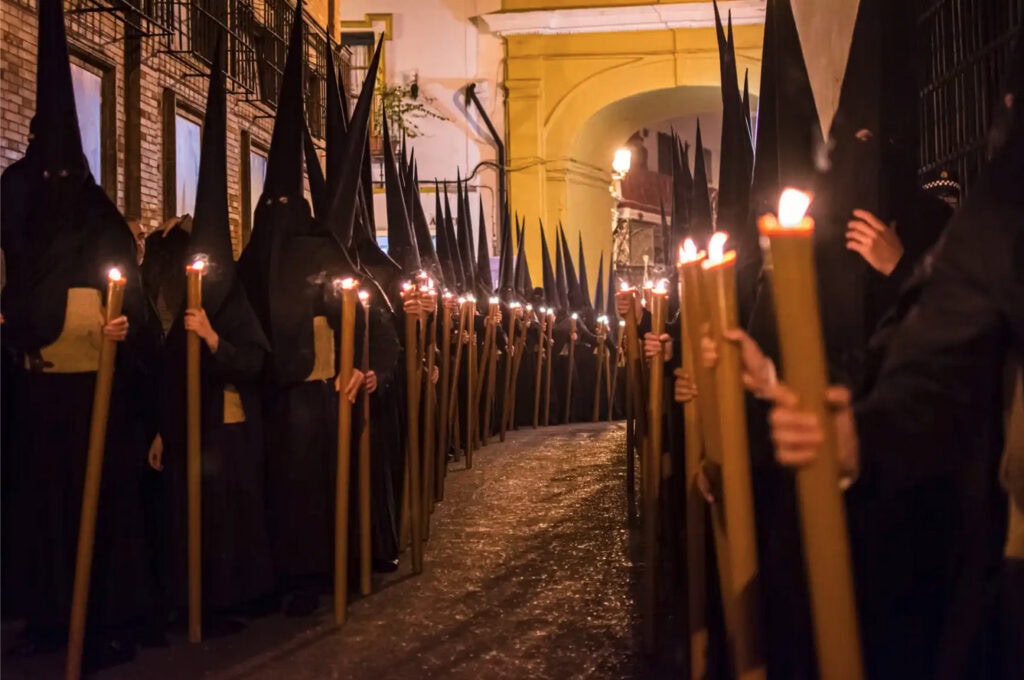
The Semana Santa brotherhoods (hermandades, also known as cofradías), are religious fraternities that organize and carry out the Holy Week processions in Seville.
The Cathedral and Giralda Tower are closed to visitors in the afternoon during Semana Santa.
Secure your visit booking a guided visit in advance! You’ll access the Cathedral and the Giralda with skip-the-line tickets, and you’ll benefit from a knowledgeable guide.
To simplify it, brotherhoods are associations of members of the parish who organize themselves to celebrate Easter with processions.
During the rest of the year they work and prepare the processions that will take place during the Holy Week. But they also carry on other religious activities.
What is a Semana Santa brotherhood?
Affiliated with their local Catholic church, an hermandad is an association whose members are Catholic laypersons. It can also be known as cofradía de penitencia (penance confraternity).
Their main purpose is to organize and perform public religious acts. They are also focused on community good works and maintaining traditional values.
Back in the day, a cofradía was a sort of professional guild (e.g. a fisherman’s brotherhood or cofradía de pescadores) while an hermandad had members from all sorts of professions, trades and backgrounds.
Both associations were founded around the 13th century, at the end of the Middle Ages, when guild associations were very common.
These groups arose as a natural response to the insecurity of the time. In those centuries, only a small group of privileged people could gain access and become members. The meetings of the members took place in local parishes, depending on their size. The brotherhoods and confraternities of the time also helped in the funerals and masses of the deceased members, as economic and spiritual help for the family.
Over the years, the cofradías and hermandades have become pretty much the same thing, with the distinct naming kept for traditional reasons. Nowadays there are 100+ brotherhoods in Seville alone.
The main member of the hermandad or cofradía is the hermano mayor (elder), representing it at every official event.
What is the main role of a brotherhood?
In Seville, Semana Santa processions are the heart of brotherhoods as they represent the main event of Christ’s life (His Death and Resurrection). They are also the best occasion to prove their faith as well as achieve public penance. Consequently, every member of the hermandad is actually performing penance during the procession.
Even though the main subject and the feelings processions inspire have to do with grief, sadness, mourning, repentance and devotion, they are absolutely spectacular. You shouldn’t miss these astonishing celebrations.
In Seville alone, their are 60 different brotherhoods who take part in the Semana Santa processions. Brotherhoods are the core of Semana Santa as they are responsible for organizing, financing and delivering the event in full swing.
Apart from the Easter activities, brotherhoods carry on other activities throughout the year such as minor processions as well as charity actions and works for the community.
Are all brotherhoods identical?
The brotherhoods are grouped around the invocation or fervor of a religious figure, Christ, the Virgin or the relic of a Saint. Among the different types of religious brotherhoods are:
- Sacramental brotherhoods. Their function is to cultivate adoration and devotion to the Blessed Sacrament.
- Penitential brotherhoods. Those that make a public penitential station.
Each confraternity has its own colors and insignia. Media images of the processions typically feature white or black tunics or capirotes, but confraternities have adopted a range of colors for their costumes, including purple, green, blue, and red.
Generally, the darker the tunic of the nazarenos, the more serious the brotherhood is.
Another sign of solemnity is the use or not of music bands. If the procession is accompanied by the roar of marches with bugle, drums or melodies, in theory it’s more relaxed than those that go in silence or with funeral melodies.
Why Sevillanos join a brotherhood
Membership is open to any baptized person. However, each brotherhood has its own internal rules deciding:
- Who can participate in a procession.
- The different organs governing it.
It’s very frequent among Sevillanos to belong to one (or more) brotherhoods. And for certain people, rising through the ranks of his (or her) brotherhood is one of the greatest honors a Sevillano can earn.
If you ask them what drove them to pick this or that hermandad, you’ll get multiple answers. Some follow a family tradition while others identify themselves with the neighborhood one or just choose according to their personal preference.
Brotherhoods coordinate the Semana Santa events
Up to 60 brotherhoods process from their own chapel or the church they are attached to the Cathedral and return back. Besides, 9 more hermandades and cofradías process on the Friday and Saturday before Palm Sunday.
Just to give you an idea of how many people can be involved, the number of nazarenos can go from 100 (Santo Entierro) to over 3,000 (La Macarena)… And this represents only part of the people involved in the procesion!
Add to this lots of Sevillanos showing devotion for their Cristo or Virgen, outsiders coming from far away to enjoy the Holy Week and other curious people – among whose you’ll find me, and the hordes walking in the narrow streets of the city center can be phenomenal!
As you can imagine, such an event needs to be carefully planned and scheduled. Every brotherhood deserves its own place and prominence. For this reason, the Consejo Superior de Hermandades y Cofradías (Supreme Council of Brotherhoods) was founded in 1930.
The Council plays a double role:
- It establishes and agrees with the local authorities (usually the City Council) the official itinerary and schedule of each hermandad.
- It acts as the link between the Archbishop and each brotherhood.
Members of the Council are elected every 4 years among the hermanos mayores (elders).
All the Semana Santa brotherhoods in Seville
xxx
Domingo de Ramos (Palm Sunday)
Here are the Semana Santa brotherhoods that parade on Palm Sunday:
Hermandad de la Borriquita
- It marks the beginning of Semana Santa with a procession popular among children, symbolizing Jesus’ triumphant entry into Jerusalem.
- Paso de Misterio features Jesus riding a donkey, greeted by the people of Jerusalem.
- Notable for the involvement of young nazarenos.
Hermandad de Jesús Despojado
- Established in 1936, this brotherhood reflects on the moment Jesus was stripped before crucifixion.
- Nuestro Padre Jesús Despojado de sus Vestiduras is poignant depiction of Jesus being stripped.
- Virgen de los Dolores y Misericordia accompanied by Saint John, emphasizes compassion and mercy.
Hermandad de la Hiniesta
- Founded in 1412, this brotherhood is renowned for its deep-rooted history and devotion.
- Cristo de la Buena Muerte represents Christ’s serene acceptance of death.
- Virgen de la Hiniesta is revered Marian image symbolizing purity and grace.
Hermandad de la Paz
- Founded in 1939 in the El Porvenir neighborhood, this brotherhood is known for its serene and elegant procession.
- Nuestro Padre Jesús de la Victoria depicts Jesus receiving the cross.
- Virgen de la Paz holds a silver olive branch, symbolizing peace.
Hermandad de la Cena
- With origins tracing back to the 16th century, this brotherhood portrays the institution of the Eucharist.
- Señor de la Sagrada Cena: Depicts Jesus at the Last Supper.
- Virgen del Subterráneo honors the Virgin Mary in a sorrowful yet graceful representation.
Hermandad de San Roque
- Established in 1901, this brotherhood is known for its heartfelt processions through the San Roque parish.
- Señor de las Penas depicts Jesus carrying the cross with a look of profound sorrow.
- Virgen de Gracia y Esperanza symbolizes grace and hope, offering solace to the faithful.
Hermandad de la Amargura
- One of the oldest brotherhoods, it emphasizes the sorrow of the Virgin Mary.
- Nuestro Padre Jesús del Silencio depicts Jesus in silent suffering before Herod.
- Virgen de la Amargura is an iconic image reflecting the deep sorrow of Mary.
Hermandad de la Estrella
- Known as “La Valiente” (The Brave One) for being the only brotherhood to process during the tumultuous times of 1932.
- Señor de las Penas shows Jesus in a moment of contemplation before his crucifixion.
- Virgen de la Estrella is beloved Marian figure, representing guidance and hope.
Hermandad del Amor
- Founded in 1508, this brotherhood focuses on the themes of love and sacrifice.
- Cristo del Amor represents Christ’s crucifixion as the ultimate act of love.
- Virgen del Socorro symbolizes the Virgin Mary’s role as a source of comfort and aid.
Lunes Santo (Holy Monday)
Here are the Semana Santa brotherhoods that parade on Holy Monday:
Hermandad de San Pablo
- Established as a penitential brotherhood in 2005, they made their inaugural procession to the cathedral in 2008.
- The mystery paso features Jesús Cautivo y Rescatado, accompanied by figures including Herod Antipas and Roman soldiers.
- Notable for its extremely long procession.
Hermandad de la Redención
- Founded in 1955 at the Church of Santa María la Blanca, they commenced their penitential processions in 1959.
- The mystery paso depicts the moment Judas Iscariot betrays Jesus with a kiss in the Garden of Gethsemane.
- Known for the fervent devotion to their titular Virgin, Nuestra Señora del Rocío.
Hermandad de Santa Genoveva
- Established in 1956 in the Tiro de Línea neighborhood, with their first procession to the cathedral in 1958.
- Features the image of Nuestro Padre Jesús Cautivo.
- The procession is notable for the large number of women accompanying the paso of the Virgin.
Hermandad de Santa Marta
- Founded in 1948 by members of the hospitality sector, initially based in the Church of San Bartolomé and later moved to San Andrés.
- The mystery paso represents the Transfer of Christ to the Sepulcher, showcasing a solemn scene of Christ’s body being carried to the tomb.
- This is one of the shortest processions of the Semana Santa in Seville and one of the most difficult to see in the streets.
Hermandad de San Gonzalo
- Founded in 1942 by young devotees aged between 12 and 17, this brotherhood has grown to be one of the most prominent in the Triana district.
- The mystery paso depicts Jesus before the high priest Caiaphas, accompanied by other figures, illustrating the moment of Christ’s condemnation.
- Accompanied by the revered image of Nuestra Señora de la Salud Coronada, the crowned Virgin of Health.
Hermandad de la Vera Cruz
- Established in 1448 in the Franciscan convent known as Casa Grande de San Francisco, making it one of the oldest brotherhoods.
- The Cristo paso presents Jesus deceased on the cross, emphasizing the moment of His sacrifice.
- Known for its simplicity and solemnity, reflecting the Franciscan influence.
Hermandad de las Penas
- Founded in 1875 at the Parish of San Vicente, with processions resuming in 1923 after a brief hiatus.
- The mystery paso portrays one of Christ’s falls while carrying the cross, emphasizing His suffering.
- Renowned for the exquisite embroidery of the Virgin’s mantle.
Hermandad de las Aguas
- Originally founded in 1750 in San Jacinto and reorganized in 1891, this brotherhood has a rich history.
- The Cristo paso features Jesus crucified with an angel holding a chalice to collect the blood and water from His side.
- The Virgin Mary is venerated under the title Nuestra Señora de Guadalupe.
Hermandad del Museo
- Established in 1575 by the silversmiths’ guild in the Parish of San Andrés, later moving to the Convent of La Merced, now the Museum of Fine Arts.
- The Cristo paso showcases the Mercy of Christ, a masterpiece by sculptor Marcos Cabrera.
- The Virgin, Nuestra Señora de las Aguas, initially processed alongside the Christ but has had her own paso since 1922.
Martes Santo (Holy Tuesday)
Here are the Semana Santa brotherhoods that parade on Holy Tuesday:
Hermandad del Cerro del Águila
- Established in 1955 by residents of the Cerro del Águila neighborhood, aiming to bring Semana Santa traditions to their community.
- Nuestro Padre Jesús de la Humildad depicts Christ carrying the cross with profound humility.
- Notable for its deep-rooted community involvement and the heartfelt devotion of its members.
Hermandad de San Benito
- Originating in 1554, it was re-established in 1921, blending historical traditions with renewed fervor.
- Misterio de la Presentación al Pueblo: is an intricate scene where Christ is presented to the people.
- María Santísima de la Encarnación is a revered Marian image, central to the procession.
Hermandad del Dulce Nombre
- Established in 1584, with a focus on the devotion to the Holy Name of Jesus.
- Nuestro Padre Jesús ante Anás represents Jesus before Annas, capturing a poignant moment of the Passion.
- María Santísima del Dulce Nombre is known for the delicate beauty of the Virgin’s image.
Hermandad de la Candelaria
- Formed in 1921 by a group of devotees in the San Nicolás parish.
- Nuestro Padre Jesús de la Salud depicts Christ carrying the cross, emphasizing themes of health and salvation.
- María Santísima de la Candelaria is celebrated for her serene expression and intricate attire.
Hermandad de San Esteban
- Dates back to 1926, established by parishioners dedicated to penitence and charity.
- Nuestro Padre Jesús de la Salud y Buen Viaje symbolizes Christ’s journey and well-being.
- María Santísima Madre de los Desamparados is a beacon of hope for the forsaken.
Hermandad de los Javieres
- Established in 1946, it’s inspired by Jesuit traditions and the figure of St. Francis Xavier.
- Santísimo Cristo de las Almas is a solemn portrayal of the crucified Christ.
- María Santísima de Gracia y Amparo embodies grace and protection.
Hermandad de los Estudiantes
- Formed in 1924 by members of the university community, linking academia with faith.
- Santísimo Cristo de la Buena Muerte is an iconic image representing the “Good Death” of Christ.
- María Santísima de la Angustia depicts the Virgin in deep sorrow.
Hermandad de Santa Cruz
- Founded in 1904 in the Santa Cruz neighborhood, reviving older traditions from the area.
- Santísimo Cristo de las Misericordias emphasizes Christ’s mercy.
- Nuestra Señora de los Dolores is poignant image of the Virgin of Sorrows.
Miércoles Santo (Holy Wednesday)
Here are the Semana Santa brotherhoods that parade on Holy Wednesday:
Hermandad del Carmen Doloroso
- Established in 1982 in the parish of Omnium Sanctorum, it was formed to foster devotion to the Virgin of Carmen.
- Features Nuestro Padre Jesús de la Paz, depicting Jesus in the Garden of Olives, and María Santísima del Carmen Doloroso, a sorrowful Virgin.
- One of the newer brotherhoods, bringing a youthful energy to the traditions of Holy Week.
Hermandad de la Sed
- Founded in 1969 by parishioners of the Church of the Immaculate Conception in the Nervión district. It emerged to address the spiritual needs of the growing neighborhood.
- Features the Santísimo Cristo de la Sed, representing Christ expressing thirst on the cross, and Santa María de Consolación Madre de la Iglesia, symbolizing consolation.
- Known for its strong ties to the Nervión community and charitable activities.
Hermandad del Buen Fin
- Established in 1590 by a group of silk weavers and dyers, it has undergone several transformations, including a period of inactivity before its revival in the 20th century.
- Includes the Santísimo Cristo del Buen Fin, a depiction of the crucified Christ, and Nuestra Señora de la Palma, representing the Virgin Mary.
- Maintains a close relationship with the Franciscan community, reflecting its historical roots.
Hermandad de San Bernardo
- Founded in 1748 in the San Bernardo neighborhood, historically associated with workers from the local slaughterhouse.
- Features the Santísimo Cristo de la Salud, depicting Christ crucified, and María Santísima del Refugio, a sorrowful Virgin.
- Known for its dramatic passage through the Puente de San Bernardo during the procession.
Hermandad de la Sagrada Lanzada
- Established in 1591, it has a rich history marked by periods of decline and resurgence, now based in the Church of San Martín.
- Central figure is the Santísimo Cristo de la Sagrada Lanzada, depicting the moment Christ’s side is pierced, accompanied by Nuestra Señora de Guía and María Santísima del Buen Fin.
- The paso includes a representation of the Roman soldier Longinus on horseback.
Hermandad del Baratillo
- Founded in 1693 near the old Baratillo market, it has deep ties to the bullfighting community due to its proximity to the Maestranza bullring.
- Features Nuestro Padre Jesús de la Misericordia and a dual-virgin paso with Nuestra Señora de la Piedad and María Santísima de la Caridad en su Soledad.
- Strong association with the bullfighting tradition, often attended by members of the bullfighting fraternity.
Hermandad de las Siete Palabras
- Originating in 1561, it has a complex history involving mergers with other brotherhoods and is now based in the Church of San Vicente.
- Presents three pasos: Santísimo Cristo de las Siete Palabras, depicting Christ on the cross; Santísimo Cristo de la Misericordia; and Nuestra Señora de la Cabeza, representing the Virgin Mary.
Hermandad del Cristo de Burgos
- Established in 1883, centered around the veneration of the Cristo de Burgos, a revered image from the 16th century.
- The primary image is the Santísimo Cristo de Burgos, a strikingly realistic depiction of the crucified Christ, and Madre de Dios de la Palma, representing the Virgin Mary.
- The procession is known for its solemnity and silent atmosphere.
Jueves Santo (Maundy Thursday)
Here are the Semana Santa brotherhoods that parade on Maundy Thursday:
Hermandad de los Negritos
- Established around 1393 by Cardinal Gonzalo de Mena y Roelas, this brotherhood was created to support and provide refuge for enslaved individuals of African descent in Seville.
- Cristo de la Fundación is a revered image crafted by Andrés de Ocampo in 1622.
- Virgin Mary Figure is an anonymous Byzantine-style sculpture.
Hermandad de la Exaltación
- Originated from the merger of the Sacramental Brotherhood of the Church of Santa Catalina and the Brotherhood of Nazarenes of the Holy Christ of Exaltation and Our Lady of Tears, initially founded in the Church of San Benito.
- Receives the nickname of “Los Caballos” (The Horses) and is known for the prominent depiction of horses in their paso.
- Nuestra Señora de las Lágrimas is a venerated image of the Virgin Mary.
Hermandad de las Cigarreras
- Founded in 1563 at the Convent of San Benito of the Order of Calatrava, with its first rules approved in 1569 by Archbishopric Provisor Cristóbal de Padilla. King Alfonso XIII granted them the purple banner of Castile.
- It has historical ties to the Tobacco Factory as its members were historically workers from Seville’s tobacco factory.
- It’s nique among Semana Santa processions for featuring Roman figures adorned with black feathers.
Hermandad de Montesión
- Established in 1560, with early members including ship patrons. Some origins are also linked to a brotherhood based in the Church of Santa Paula.
- María Santísima del Rosario features one of the city’s most elegant and distinctive palios, adorned with rosaries that produce a characteristic sound as they strike the varales (poles).
- Their procession through Calle Feria is a highlight of Maundy Thursday.
Hermandad de la Quinta Angustia
- Resulted from the fusion of the Brotherhood of the Sacred Descent of Our Lord Jesus Christ and the Fifth Anguish of the Blessed Virgin Mary with the Brotherhood of the Sweet Name of Jesus.
- It’s renowned for their paso depicting the descent of Christ from the cross.
Hermandad del Valle
- Formed in 1590 through the union of two brotherhoods at the Convent of El Valle. It was the first Sevillian brotherhood to receive the title of archconfraternity, granted by Pope Pius VII.
- It’s notable for carrying three distinct pasos during their procession.
- It houses significant religious artworks and sculptures.
Hermandad de Pasión
- Founded in October 1535 by a group of Castilian devotees, with its first seat in the Convent of La Merced.
- Jesús de la Pasión is masterpiece sculpture by Juan Martínez Montañés, central to their procession.
- Their disciplined and solemn procession through Seville’s streets is a hallmark of Maundy Thursday.
La Madrugá (Good Friday morning)
La Madrugá, the early hours of Good Friday, is the pinnacle of Seville’s Semana Santa, featuring six prominent brotherhoods (hermandades) that process through the city.
Here are the Semana Santa brotherhoods that parade on Good Friday morning:
Hermandad del Silencio
- Established in 1340 at the Church of Omnium Sanctorum, it’s considered the oldest existing brotherhood in Seville.
- Known for its strict adherence to silence and penitence during processions.
- Features the image of Nuestro Padre Jesús Nazareno, attributed to Francisco de Ocampo (1609), and María Santísima de la Concepción, sculpted by Sebastián Santos (1954).
Hermandad de Jesús del Gran Poder
- Founded in 1431 by the Dukes of Medina Sidonia in the Convent of San Benito de Calatrava. The image of Jesús del Gran Poder, created by Juan de Mesa in 1620, is one of the most venerated in Seville.
- The procession includes the Señor del Gran Poder and the Virgen del Mayor Dolor y Traspaso, an anonymous work from the 18th century.
Hermandad de la Esperanza Macarena
- Established in 1595 by the guild of gardeners in the now-defunct Convent of San Basilio.
- The revered image of the Virgen de la Esperanza Macarena was canonically crowned in 1964 and received the Gold Medal of the City of Seville in 1971.
- Features Nuestro Padre Jesús de la Sentencia, depicting the moment of Christ’s sentencing, and María Santísima de la Esperanza Macarena.
- It’s accompanied by the “Armaos”, a group dressed as Roman soldiers, adding a distinctive element to the procession.
Hermandad del Calvario
- Originating in 1571, it was re-established in 1886 in San Ildefonso as the successor to the former “Hermandad de los Mulatos”. It moved to the Parish of La Magdalena in 1916, where it currently resides.
- The procession includes the Santísimo Cristo del Calvario, a depiction of the crucified Christ by Francisco de Ocampo (1612), and the Virgen de la Presentación, attributed to Gabriel de Astorga (1845).
Hermandad de la Esperanza de Triana
- Founded in 1418 by the guild of ceramists, the brotherhood is based in the Chapel of the Mariners in the Triana district.
- The Virgen de la Esperanza de Triana was canonically crowned in 1984 by a papal bull from John Paul II.
- Features the Santísimo Cristo de las Tres Caídas, depicting one of Christ’s falls on the way to Calvary, and the Virgen de la Esperanza de Triana.
- As patroness of sailors, the brotherhood’s emblem includes an anchor, reflecting its maritime heritage.
Hermandad de Los Gitanos
- Established in 1753 in the Convent of the Holy Spirit in Triana by Sebastián Miguel de Varas and other devout gypsies.
- The brotherhood has strong ties to the House of Alba, which donated a mantle for the Virgin adorned with its coat of arms.
- The procession includes the Señor de la Salud, a depiction of Christ carrying the cross by Fernández Andes (1939), and the Virgen de las Angustias, also by Fernández Andes (1937), who was canonically crowned in 1988.
Viernes Santo (Good Friday afternoon)
Here are the Semana Santa brotherhoods that parade on Good Friday afternoon:
Hermandad de la Carretería
- Established in the late 16th century by workers associated with the river docks and carriage guilds, reflecting Seville’s maritime and trade significance.
- It features intricate pasos depicting the Crucifixion and a sorrowful Virgin Mary.
- It processes through the Arenal district, emphasizing Seville’s historical connection to trade and the river.
Hermandad de la Soledad de San Buenaventura
- Originated in 1656 by devotees who established a hermandad in honor of the Santa Cruz at the Caño Quebrado cemetery, later moving to the San Buenaventura convent in 1849.
- It depicts the Virgin in solitude at the foot of the cross, emphasizing mourning and reflection.
Hermandad del Cachorro
- Established in 1689 in the Triana district, with strong ties to the local gypsy community.
- Cristo del Cachorro is a renowned sculpture by Francisco Antonio Ruiz Gijón (1682) capturing Christ’s final breath.
- The route crosses the iconic Triana Bridge, connecting the neighborhood’s deep cultural roots with the city center.
Hermandad de la O
- Transitioned from a 16th-century Hermandad de Gloria to a penitential brotherhood, with rules approved in 1566
- It’s notable for being the first Triana brotherhood to cross the river for its penance station in 1830.
- Jesús Nazareno depicts Jesus carrying the cross, a work by Pedro Roldán from 1685.
- María Santísima de la O was canonically crowned in 2007, highlighting her significance in the community.
Hermandad de San Isidoro
- Established in 1605, originally linked to the guild of tailors, reflecting the city’s artisanal heritage.
- Jesús de las Tres Caídas represents Christ’s three falls on the way to Calvary.
- Nuestra Señora de Loreto honors the patroness of aviation, reflecting a unique devotion within the brotherhood.
Hermandad de Montserrat
- Established in 1601 by Catalan merchants residing in Seville, reflecting the cultural exchange within the city.
- Cristo de la Conversión is a revered sculpture by Juan de Mesa (1619) portraying the moment of the Good Thief’s conversion.
- It includes representations of biblical figures like the Verónica and allegorical figures, adding depth to the procession.
Hermandad de la Sagrada Mortaja
- Established in 1500 by devotees focused on the burial of Christ, emphasizing the Passion’s final moments.
- Sagrada Mortaja depicts the poignant scene of Christ’s body being prepared for burial.
- Known for its solemn and reflective atmosphere, with minimal musical accompaniment.
Sábado Santo (Holy Saturday)
Here are the Semana Santa brotherhoods that parade on Holy Saturday:
Hermandad del Sol
- Originating from a children’s procession in 1932, the Hermandad del Sol was officially established in 1932. It has evolved into a significant part of Seville’s Holy Week traditions.
- The procession features the Señor Varón de Dolores, an allegorical representation unique in Seville’s Semana Santa.
- The Virgen del Sol is carried under a uniquely designed canopy, depicting the Sacra Conversación with figures of Saint John and Mary Magdalene.
Hermandad de los Servitas
- Established on August 16, 1696, as part of the Servite Order, this brotherhood initially focused on devotional practices without organizing processions.
- It’s known for its austere and reflective procession, emphasizing the sorrow of the Virgin Mary.
Hermandad de la Trinidad
- Founded in 1507 by a group of gardeners at the Convent of the Trinity, this brotherhood has a longstanding presence in Seville’s religious community.
- Introduced a new Crucifixion scene in 2002, enhancing the visual narrative of their procession.
- It maintains strong ties with local communities, reflecting its origins among working-class gardeners.
Hermandad del Santo Entierro
- Traditionally believed to have been founded by King Fernandio III after the conquest of Seville in the 13th century, symbolizing royal patronage.
- It features a distinctive float known as “La Canina”, representing the Triumph of the Holy Cross over Death.
- It organizes the “Santo Entierro Magno”, a grand procession involving multiple brotherhoods, on special occasions.
Hermandad de la Soledad de San Lorenzo
- Established in the 16th century, this brotherhood has a rich history intertwined with Seville’s devotional practices.
- It parades a single paso featuring the Virgin of Soledad at the foot of the Cross, emphasizing mourning and solitude.
- The image of the Virgin is a revered figure, attracting deep devotion from the local community.
Domingo de Resurrección (Easter Sunday)
Here are the Semana Santa brotherhoods that parade on Easter Sunday:
Hermandad de la Resurección
- Founded in 1972, this is one of Seville’s youngest Semana Santa brotherhoods, created with a very specific mission: to restore the final, joyful chapter of the Passion narrative to the Holy Week calendar – the Resurrection of Christ.
- While most processions focus on sorrow and sacrifice, this brotherhood celebrates hope, light, and renewal, marking the victorious conclusion to the week.
- The image of the Risen Christ, sculpted by Francisco Buiza in 1973, is a powerful, triumphant figure – radiant, with arms outstretched in victory. He walks alone on the float, symbolizing new life.
This article is part of a complete tutorial on Semana Santa in Seville where you can read all the information you need to organize your experience during this magical and unique week.
Here is a complete summary of all the guide:
1. Semana Santa dates in Seville
2. Seville Holy Week processions: a local’s guide to Semana Santa
3. Daily schedule of each procession in Seville
4. Best spots to see the Seville Easter parades each day
5. Easter in Seville: 9 insider tips to experience Semana Santa
6. When to visit the home churches during Easter
7. 8 tips for celebrating Holy Week in Seville with children
8. What are the Semana Santa brotherhoods (hermandades)
